Need help with pressure or safety? Open discreet support options.Find safe help →
No quiz and no deadline

What if I am actually questioning my gender?

You can explore what words mean without being pushed toward or away from any identity.

The 30-second answer

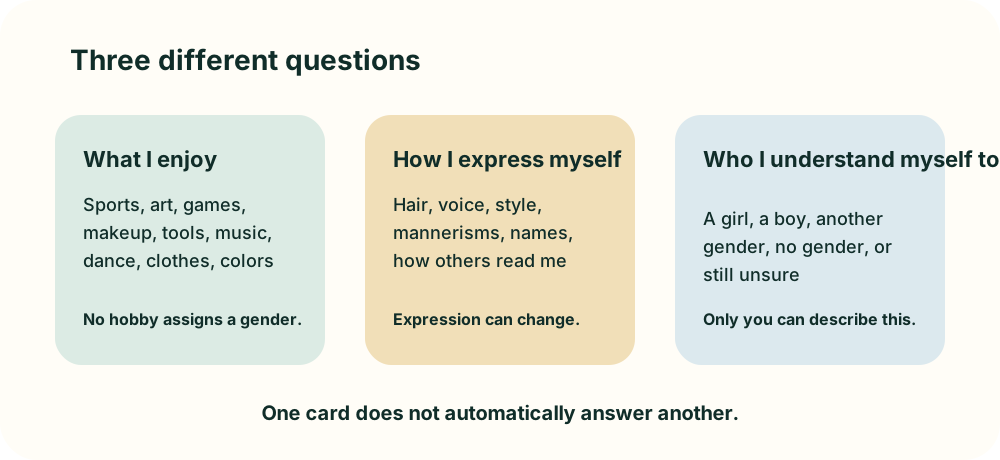
Questioning does not obligate you to become anything. Some people eventually understand themselves as transgender or nonbinary. Others decide they are a girl or boy who does not fit stereotypes. Some remain unsure. A safe process leaves room for all of those outcomes.

Useful terms, without assigning them to you

TransgenderA person whose gender identity differs from the sex assigned at birth.
NonbinaryA person whose gender identity is not only a boy/man or only a girl/woman.
QuestioningExploring gender identity, expression, or orientation without a settled answer.
IntersexVariations in anatomy, hormones, chromosomes, or other sex traits. This is not the same as a gender identity.

Definitions can help you understand conversations. They cannot decide which word fits you.

Explore low-pressure questions

  • Which feelings come from stereotypes or bullying, and which feel more internal?
  • Do I want freedom to act differently, or do I also want others to understand me as a different gender?
  • Does trying a private nickname or pronoun feel useful, neutral, uncomfortable, or simply unclear?
  • Who is safe enough to talk with, and what could happen if this information spreads?

You do not have to test yourself by posting publicly, sending photos, joining adult spaces, taking unprescribed medication, or telling an unsafe person.

Support should not force an outcome

A qualified professional should make room for development, family and cultural context, mental health, safety, body distress, stereotypes, and uncertainty. They should not shame you into conformity or pressure you to adopt a label. Medical questions require a properly qualified clinician and individualized care; this website cannot assess treatment.

Privacy and coming out

Coming out is not a moral duty. Think about housing, school, money, transportation, device privacy, and who could support you if another person reacts badly. A private conversation with a safe adult can begin with boundaries: ask what they must share before giving details.

When to get help promptly

Distress is taking over
Seek support when worry, body distress, bullying, or conflict is stopping sleep, school, eating, friendships, or ordinary activities.
You may be harmed or thrown out
Do not confront an unsafe person alone. Use the safety route to plan another adult, place, phone, or service.

Words you can use

“I am questioning how I understand my gender. I need someone who will listen without trying to force me toward any answer.”
Sources and limits: CDC definitions distinguish identity, expression, orientation, transgender, nonbinary, questioning, and intersex. ACOG supports inclusive communication while preserving precise descriptions of anatomy and study populations. This page does not diagnose gender dysphoria or recommend treatment.
CDC terminology · ACOG inclusive language policy · WHO adolescent-care standards
No shame, direct answers

Questions people ask privately

Is there a quiz that can tell me my gender?

No reliable quiz can decide an internal identity. Online quizzes may help you notice feelings, but they cannot diagnose or assign you.

Do I need to come out to explore?

No. You can think privately or speak with one safe person. Public disclosure is not required, especially when housing or safety could be affected.

Can questioning turn out to be about stereotypes?

Yes. Some people mainly need freedom from gender rules. Others find that identity itself feels different. Both deserve room to be understood.

What if my feelings change?

Changing words or understanding is not dishonesty. Adolescence involves learning about yourself, and uncertainty can be real.

Should a counselor tell me what I am?

No. A good counselor helps you describe experiences, safety and goals without forcing conformity or a transgender identity.

What about medical treatment?

That requires individualized care from properly qualified clinicians. A website or peer cannot assess benefits, risks, timing, consent or medical history.